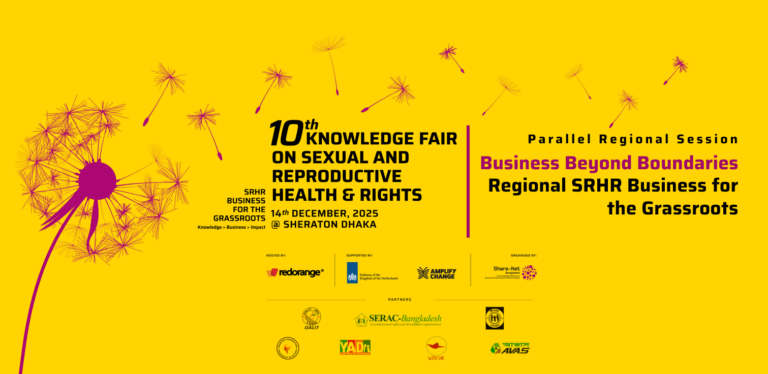
The 10th Annual Knowledge Fair 2025 hosted a regional session that explored how grassroots Sexual and Reproductive Health and Rights initiatives can evolve into sustainable business models by leveraging regional networks, cross-border partnerships, and shared markets across South Asia. The session brought together practitioners, social entrepreneurs, and programme leaders from Bangladesh, Nepal, India, and Pakistan, highlighting how locally rooted SRHR solutions can scale while retaining their community-driven focus.
The session was chaired by Mr Mukit Anis, Faculty Lead at Uddami Ami and Uddokta 101, Women Empowerment Cell, and Lecturer in Marketing at BRAC Business School. It was moderated by Ms Lamea Tanjin Tanha, Founder of TransEnd and Lecturer at the Department of Law and International Cooperation, Daffodil International University.
Participants from India, Pakistan, and Nepal presented their respective SRHR-focused. business initiatives, demonstrating diverse approaches to sustainability, access, and regional collaboration.
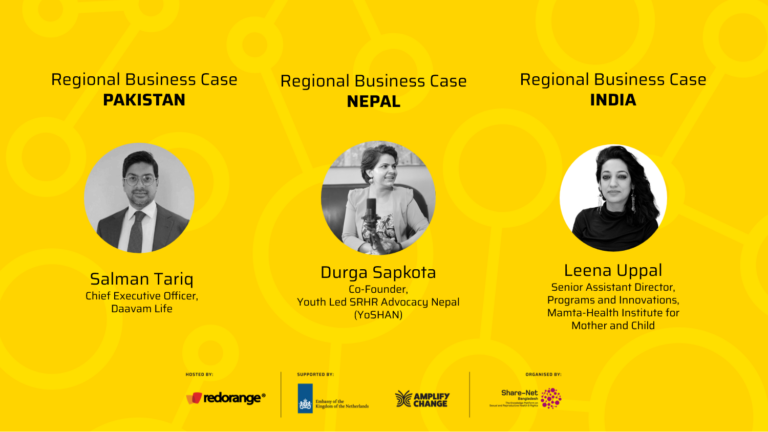
The first presentation was delivered by a participant from Pakistan, who introduced the initiative DAVAAM Life, which works towards establishing a sustainable retail chain in the country. The presenter highlighted existing gaps in the retail sector, focusing on two critical issues: “excess” and “access”. Under excess, it was noted that nearly 50 percent of the price of a consumer product is often attributed to packaging. Under access, the presenter discussed the financial barriers that limit access to necessities, particularly for low-income consumers.
To address these challenges, DAVAAM introduced refill stations where consumers can bring empty containers of products such as shampoo, detergent, dish soap, laundry detergent, and hand soap, and pay only for the quantity they wish to purchase. This model removes the cost burden of packaging and allows consumers greater flexibility in purchasing. Recognising the need to extend this model to menstrual health products, DAVAAM also introduced sanitary napkin refill stations. Through this approach, consumers are able to purchase sanitary napkins without bearing the cost of excessive packaging and can choose quantities according to their needs. DAVAAM partnered with Pakistan’s largest sanitary napkin brand to supply products for these refill stations. The overarching objective of the initiative is to incentivize consumer behaviour to reduce plastic waste while simultaneously improving access to essential products, including sanitary napkins.
The second presentation was delivered by a participant from Nepal, who introduced the initiative YOSHAN, From Reliance to Resistance. The presenter emphasized that sustainability is not merely a strategy but a form of resistance, noting that as dependency decreases, autonomy increases. YOSHAN operates youth clinics across different regions of Nepal, functioning between 5 pm and 8 pm. These clinics serve as safe and reliable spaces where gynecologists, psychosocial counsellors, and sociologists provide free services, particularly to young people. The long-term goal of YOSHAN is to become fully sustainable and self running, ensuring the continuous provision of high-quality services to those in need.
The third presentation was delivered by a participant from India, who presented the initiative MAMTA, Bringing Health, Policy, and Enterprise. Established in 1990, MAMTA has since evolved into a health institution with comprehensive and holistic coverage. According to the presenter, the organization has reached more than 70 million people over its operational lifespan. MAMTA operates across India and collaborates with neighbouring countries, including Nepal, Bangladesh, and Cambodia. Its collaborative approach focuses on identifying gaps in knowledge and practice related to health service delivery and addressing these through knowledge sharing, system strengthening, and the creation of learning platforms. A notable initiative highlighted during the presentation was the establishment of the Friends Centre in the Tigri Slum, which provides counselling and health services to adolescents and youth in the area. The presenter also shared how MAMTA designs joint projects and works in synergy with regional partners to strengthen collective impact.
Following the presentations, the session opened for a question-and-answer segment. The audience and panel engaged actively with the presenters, raising questions that were addressed in detail by the participants. The session concluded with closing remarks by the chair, marking the end of the regional session.