
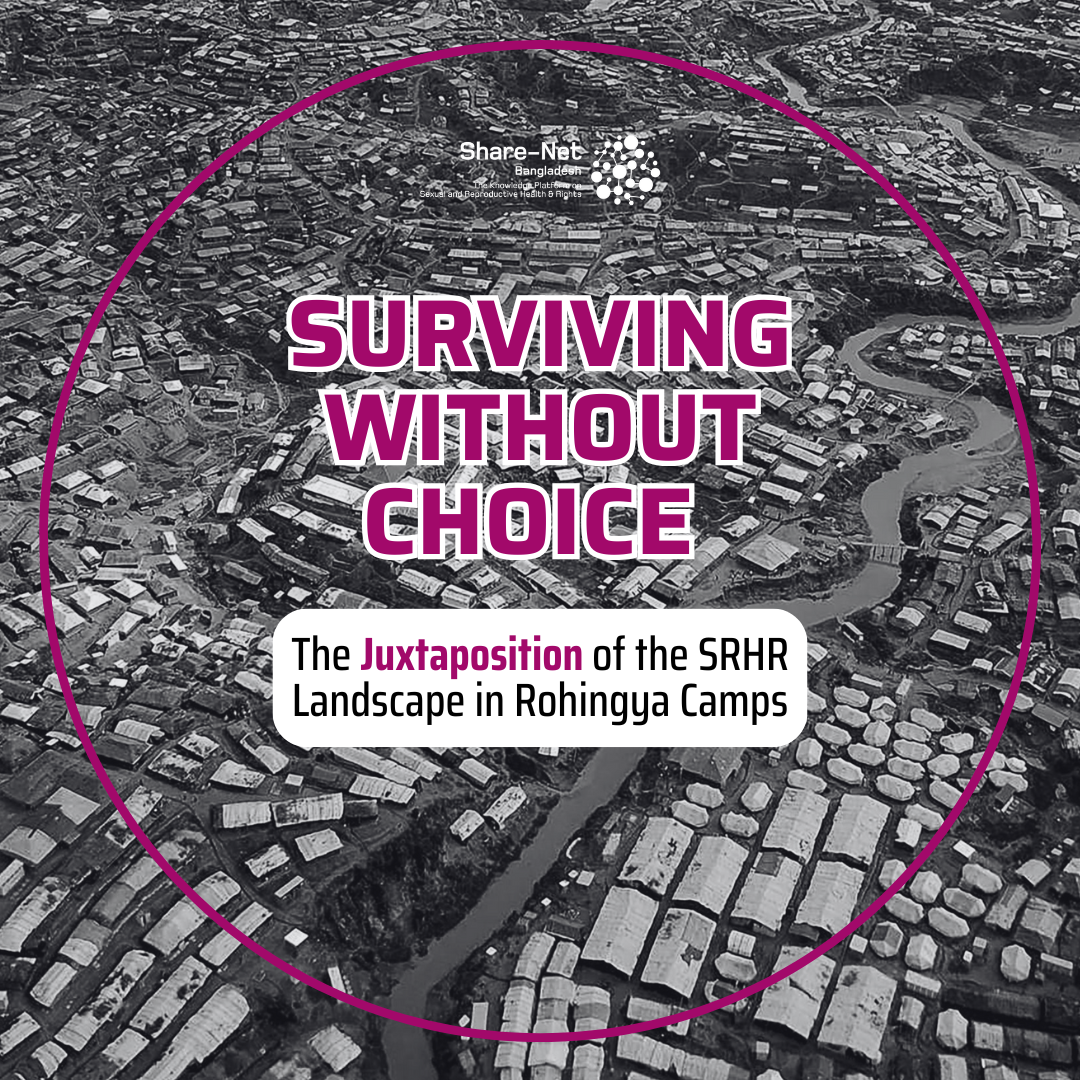
Surviving Without Choice: The Juxtaposition of the SRHR Landscape in Rohingya Camps
For nearly eight years, the hills of Ukhia and Teknaf have been a temporary home to over a million people, yet for the Rohingya, “temporary” has become a word incredibly associated with their lives. Bangladesh has been hosting this population since 2017, but the roots of this crisis stretch back much further, with waves of displacement occurring since the late 1970s.
Nearly 1.2 million Rohingya refugees live in what has become the world’s largest settlement. The lion’s share of our attention is focused on food and shelter, but we often forget another dimension of this crisis. It is the struggle for Sexual and Reproductive Health and Rights (SRHR), a domain where survival often means living without a choice.
For decades, the Rohingya were targets of state-sponsored population control, including forced birth control and restricted marriages. This history of persecution has left deep scars, creating a profound mistrust of medical systems that follows them into the camps today.
Currently, the SRHR situation is not exactly much to be proud of. More than half of the refugee population is women and girls, yet their most intimate health needs remain shrouded in stigma and logistical hurdles. A 2020 study by Ahmed et al. highlights that delivering SRH services in such humanitarian crises is essential for the health of this at-risk population. However, researchers found that sensitivity around these topics, combined with language barriers and a preference for traditional healers, makes it incredibly difficult to reach those in need.
For the youth, the barriers are even steeper. A 2025 study by Noor Kutubul Alam Siddiquee reveals that young Rohingya refugees face immense pressure from conservative social structures. Stigma and a lack of trust in healthcare providers often lead them to rely on friends or cousins for advice, which can be inaccurate or dangerous.
The data tells a sobering story. Globally, maternal mortality rates in humanitarian settings are significantly higher than the global average of 211 deaths per 100,000 live births. In the Rohingya camps, while progress has been made, the maternal mortality rate was reported at 168 per 100,000 live births in 2024. This is still a stark reality compared to the surrounding host communities. Furthermore, while the contraceptive prevalence rate among the Rohingya is roughly 42%, many women still lack the autonomy to make these decisions.
Camp officials and visitors often witness children making balloons with condoms and playing with other SRH products. The estimated total fertility rate (TFR) among Rohingya refugees in the Bangladesh camps is approximately 3.8 children per woman, significantly higher than Bangladesh’s national rate of 2.4, as reflected in the recent MICS Survey. The supply of contraceptives was never the issue. Contraceptives are well available. But their access is hindered by significant socio-cultural barriers, deeply ingrained misconceptions, and instances of coercion. In some qualitative research, the Rohingya couples report seeing reproduction in a positive light.
While a fair share of opinion supports their reproductive rights, netizens are also found complaining about this practice. “We are a small country. How can we host such a big population? And to make things worse, they are multiplying their number by the day!” said one in an interview with The Diplomat Magazine.
This does establish a juxtaposition, where a part of the development landscape sees this in a positive way and a ‘success story’ of exercising reproductive rights. However, a general frustration among the public is also seen due to the prolonged crisis, economic strain, environmental damage, reports of increased crime and reproduction rates.
Recent funding cuts have only worsened the situation, leading to the closure of several primary health posts. The Chief Advisor warns that declining aid could spark a “big explosion” of unrest. Though he proposed a Seven-Point Plan for dignified repatriation and international monitoring, no significant returns have occurred as of early 2026. Instead, ongoing conflict in Myanmar has pushed 150,000 more refugees into the camps. Without a concrete roadmap or citizenship, over 1.3 million people remain trapped in a desperate cycle of waiting.
As we look to the future, the fate of the Rohingyas remains uncertain. For a people who have lost almost everything, the right to govern one’s own body remains the final frontier of human dignity. But questions also remain on the toll their presence brings to Bangladesh. Will the story of the Rohingyas have a happy ending?
Source:
- MICS Survey Findings 2025
- The Diplomat
- UNHCR
- The Daily Star