
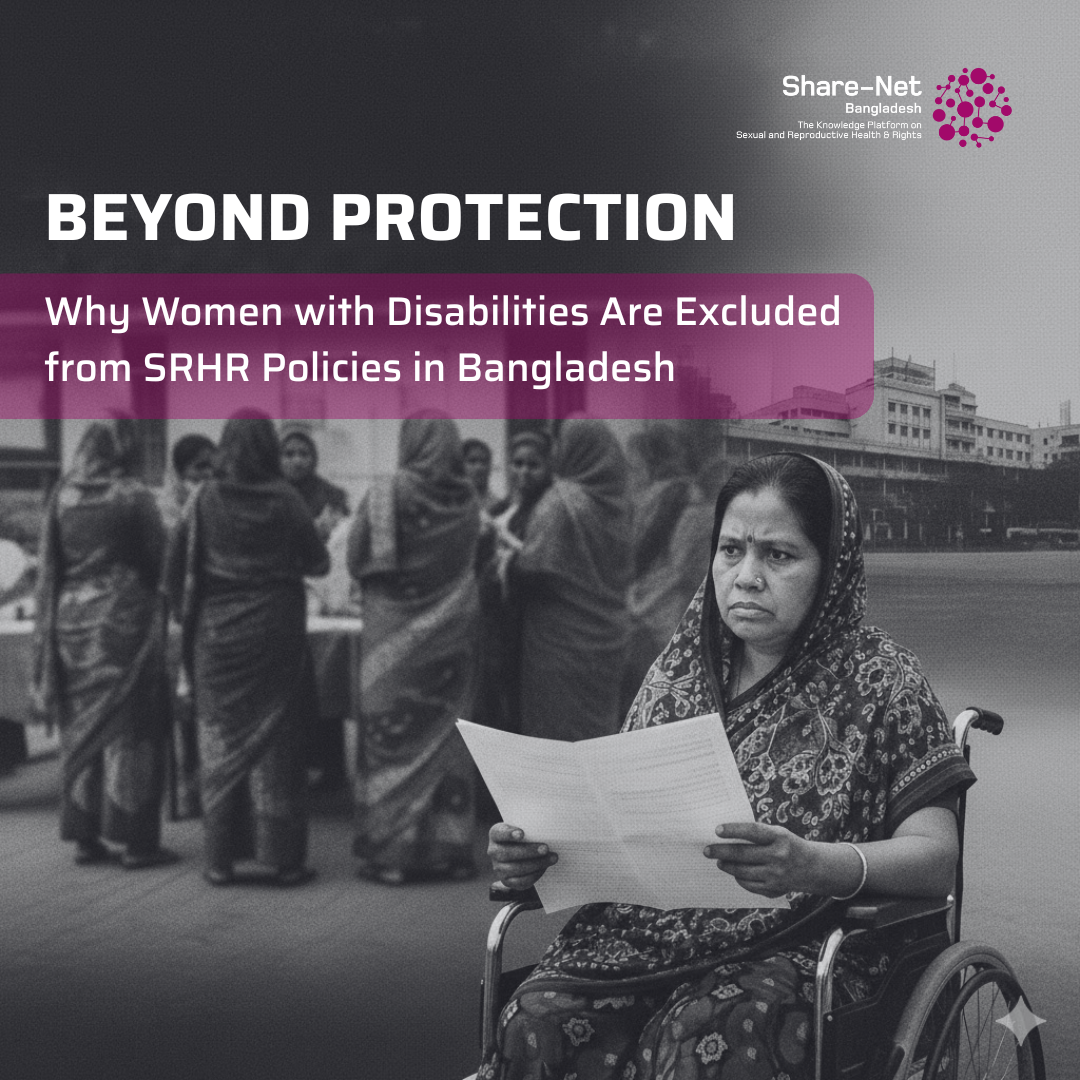
Beyond Protection: Why Women with Disabilities Are Excluded from SRHR Policies in Bangladesh
Imagine a young woman, let’s call her Maya, entering a community clinic in rural Bangladesh. She uses a wheelchair. After entering the clinic, she meets a steep flight of stairs, followed by a waiting room where the counter is too high for her to see the receptionist. When she finally sees a doctor, they don’t look at her; instead, they address Maya’s mother, asking, “Why does she need a contraceptive? She’s disabled.”
This is the reality of a “disability-blind” healthcare system, where the very people supposed to care for Maya do not even see her as a woman with desires or rights.
In Bangladesh, our policies are often built on the concept of “protection,” but for women with disabilities, protection frequently translates to the erasure of autonomy. The Rights and Protection of Persons with Disabilities Act, 2013, was a landmark step. However, it remains largely focused on welfare rather than agency. When we “protect” women by making choices for them, we strip away their right to decide what happens to their own bodies.
This exclusion is rooted in deep societal myths. As highlighted in the study “We do not dare to love: women with disabilities’ sexual and reproductive health and rights in rural Cambodia’’ by Alexandra Gartrella, women with disabilities are often viewed as “asexual” or “perpetual children.” These same perceptions exist in Bangladesh, where a woman’s disability is seen as a total eclipse of her womanhood. If society doesn’t believe someone is capable of love or sex, it sees no reason to include that person in reproductive health conversations.
Current policies in Bangladesh assume a one-size-fits-all model of reproductive health, but the actual needs of disabled women are far more complex. A systematic review on “Access to Sexual and Reproductive Health and Rights for Women with Disabilities in Africa’’ notes that barriers are not just physical, they are also deeply attitudinal. While our 2013 Act promises health services, it fails to mandate accessible exam tables or hoists. The “medical model” of disability still dominates, treating individuals like Maya as a patient to be “fixed” rather than a citizen with rights.
Even darker is the history of forced sterilisation and coerced contraception, often performed under the guise of “care” to prevent “burdening” families. For many, “care” has historically meant control. This is compounded by guardianship laws that allow family members to make life-altering medical decisions without the woman’s consent.
Furthermore, the scarcity of resources in Braille, Easy-Read, or Sign Language means Maya is often kept in the dark about her own health. “Gender-neutral” disability policies ignore the unique violence women face, while “disability-neutral” gender policies ignore the physical barriers to care.
However, there is hope. Disabled People’s Organisations (DPOs) in Bangladesh are now leading the charge for change. We are seeing progress through frameworks like the UNICEF Disability Inclusion Policy and Strategy (DIPAS), which integrates disability rights across all sectors. Additionally, research like the W-DARE program provides a localised roadmap for making reproductive services truly inclusive.
We must transition from a model of “protection” to one of “empowerment.” Policymakers must involve women with disabilities in every stage of planning. We need accessible clinics, trained staff, and laws that respect a woman’s right to choose. Only then can Maya, and thousands like her, walk or roll into a clinic knowing her rights are not a matter of charity, but a matter of justice. Nothing about us, without us.
Source:
- Taylor and Francis Online
- Springer Nature
- UNDP
- WHO