
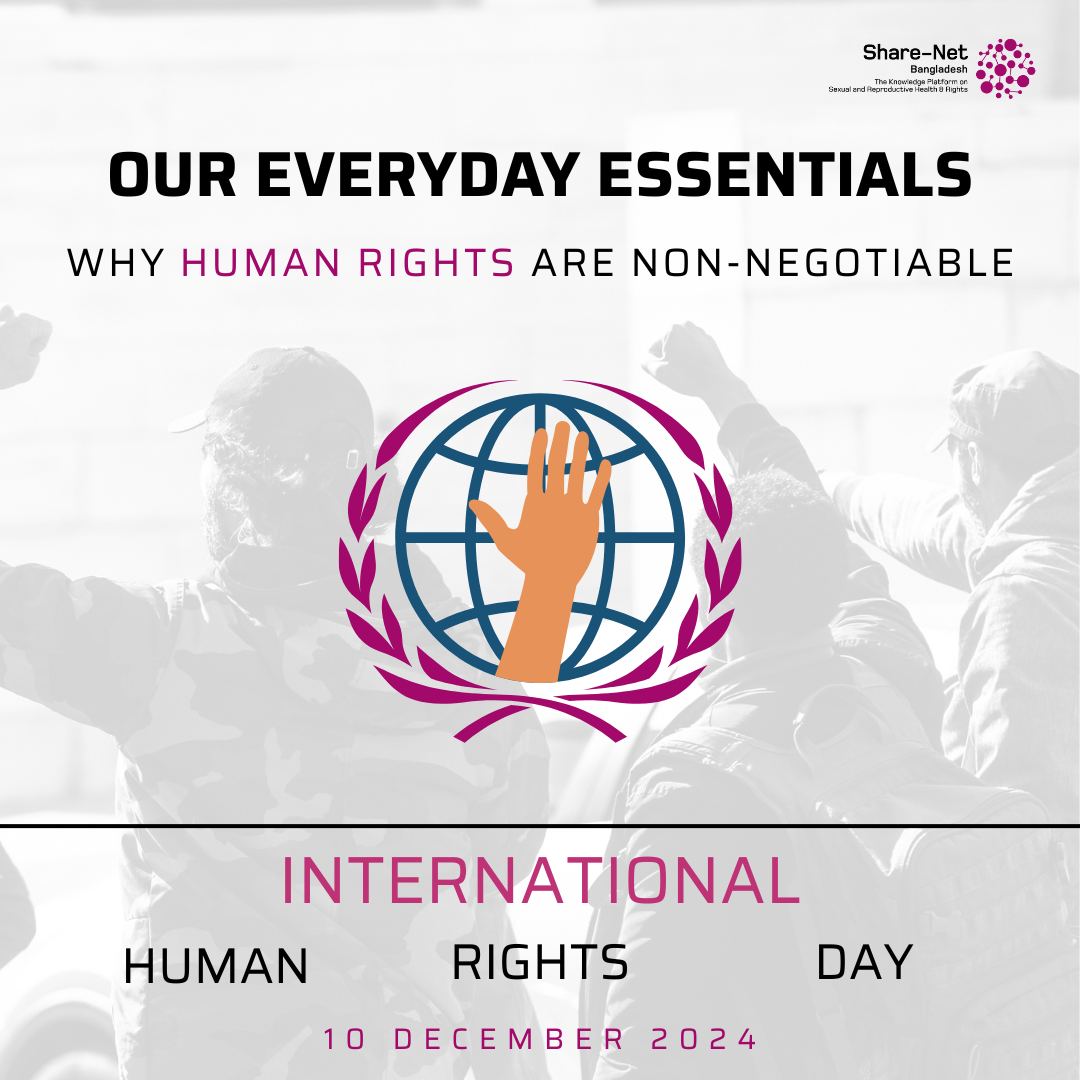
Our Everyday Essentials: Why Human Rights Are Non-Negotiable
Every 10 December, on Human Rights Day, we are reminded that dignity, freedom and justice are not luxuries; they are essentials. This time, we are observing the day under the theme “Our Everyday Essentials.’’ As we pause to reflect, we must also recognise that sexual and reproductive health and rights (SRHR) remain a core, yet often overlooked pillar of human rights.
Bangladesh is also celebrating the occasion with human chains, discussions and awareness programs organised by the National Human Rights Commission (NHRC), various rights groups, GOs, NGOs and INGOs.
The chief adviser has also issued a message to commemorate the day. In his message, Chief Adviser Yunus urged citizens to internalise human rights as a faith, ensuring dignified, discrimination-free lives for all.
The Universal Declaration on Human Rights, which was enacted in 1948, laid the foundation for all human rights, followed by key documents such as the International Covenant on Civil and Political Rights and the International Covenant on Economic, Social and Cultural Rights, which establish a collective responsibility on states to respect, protect, and fulfil civil, political, economic, social, and cultural rights. These documents affirm that every person is entitled to life, security, health, education, dignity, and freedom from discrimination-requirements that make SRHR not optional but foundational.
As Eleanor Roosevelt once said, “Where, after all, do universal human rights begin? In small places, close to home — so close and so small that they cannot be seen on any map of the world. Yet they are the world of the individual person.” That world depends on our ability to make deeply personal choices about our bodies, our health, our lives.
Across the world, human rights are still under threat. According to recent data, close to 4.3 billion people of reproductive age face discrimination in accessing sexual and reproductive health services. Every year, some 25 million unsafe abortions take place, nearly 2 million people are newly diagnosed with HIV, and about one in three women worldwide experiences intimate partner or sexual violence.
Here in Bangladesh, the scenario is grim. According to a 2024 national survey on violence against women, 76 per cent of women aged 15 and older reported having experienced at least one form of intimate partner violence in their lifetime. In just the past year alone, 49 per cent reported abuse ranging from controlling behaviours to physical or sexual violence.
Recent research among adolescents in Dhaka reveals wide gaps in knowledge, comfort and practice around SRHR: although 84.1 per cent support sexual and reproductive health education, only 51.4 per cent feel comfortable discussing these issues.
Unfortunately, human rights get lost in the shadow of bureaucracy, procrastination, activism and glamour. While another non-binding resolution gets adopted in the UN Human Rights Council-while we write another annual report on a conflict situation-while discussions, debates, and diplomacy convene, hundreds of lives are lost and their rights? Violated beyond words.
This Human Rights Day, as the world highlights “Our Everyday Essentials”, let us commit to making SRHR a reality for all and making human rights, like the theme suggests, an essential.
And so, from Share-Net Bangladesh, we wish everyone a reflective, committed and hopeful Human Rights Day. May we all remember that true human rights begin in small places, in our homes, our clinics, our communities and that every person, everywhere, deserves the essentials of dignity, safety and freedom.
Sources:
1. Dhaka Tribune
2. UNFPA
3. 2024 Violence Against Women Survey
4. The United Nations