
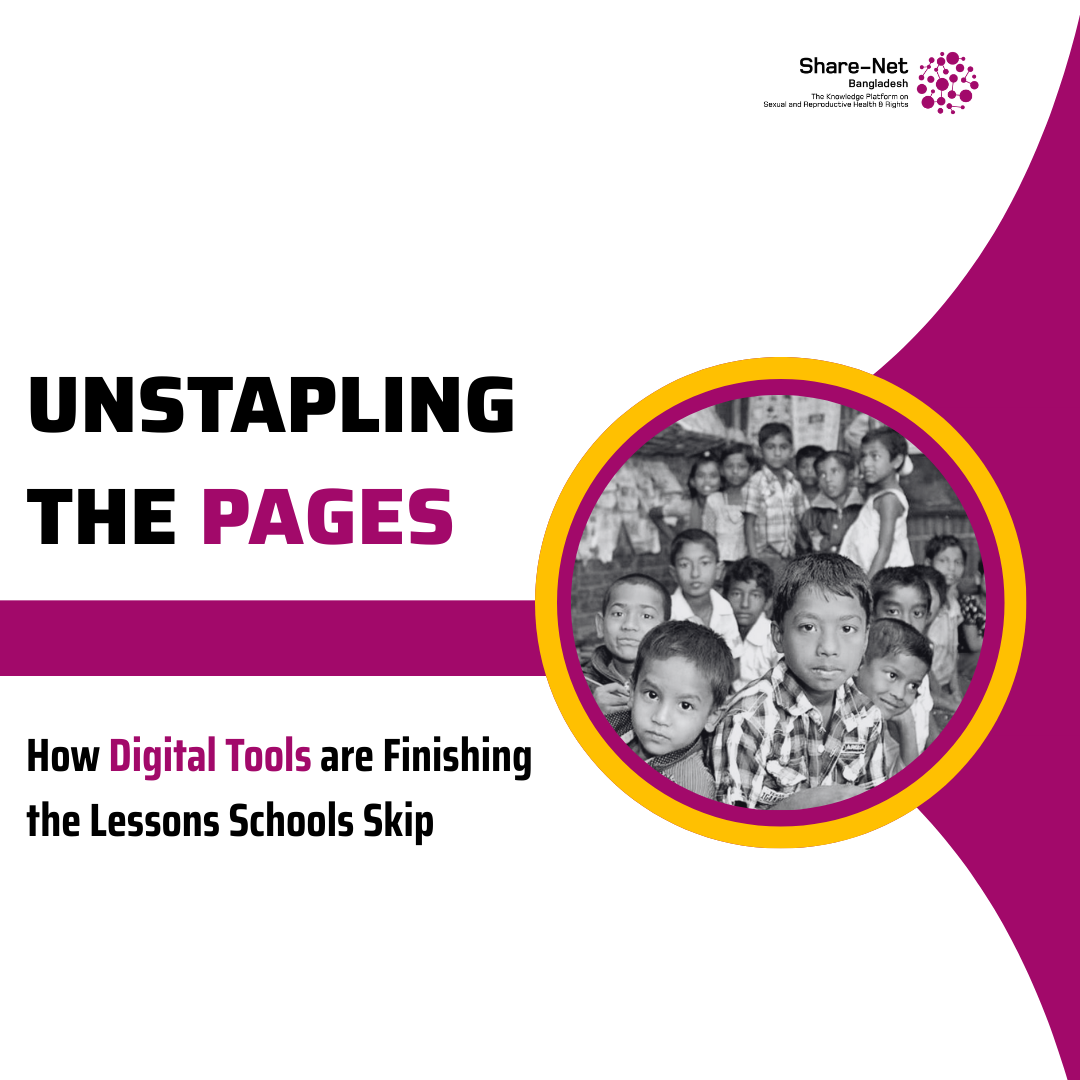
Unstapling the Pages: How Digital Tools are Finishing the Lessons Schools Skip
In many rural villages across Bangladesh, the pages of the NCTB Physical Education textbook remain suspiciously crisp. While the chapters on football or cricket are dog-eared, the sections on reproductive health are often skipped over with a quick, “Read this at home,” from an embarrassed teacher. In some conservative pockets, these pages are even stapled together. This silence creates a dangerous vacuum, but it is a vacuum that is now being filled by the soft glow of a smartphone screen.
Comprehensive Sexuality Education is one of the most important elements of Sexual and Reproductive Health and Rights. In fact, CSE is one of the nine core elements of the definition of SRHR by UNFPA. It is far more than a biology lesson. It is a curriculum that teaches young people about their bodies, their rights, and their relationships. Digital-first CSE takes this vital information and puts it into an app, a chatbot, or a WhatsApp group.
In a country where over 90 per cent of the population has access to a mobile network, the pocket educator is becoming the most reliable source of truth for the youth.
The situation is urgent. In conservative communities, especially in rural areas, talking about sexual health is often seen as a moral failing rather than a medical necessity. Traditional systems fail because they rely on human gatekeepers, such as teachers and parents, who are often burdened by their own shame or lack of training. Data suggests that while youth have high mobile penetration, their knowledge of basic reproductive rights and safety remains alarmingly low. When the classroom fails to provide facts, young people often turn to unreliable or even harmful corners of the internet.
This is where digital-first platforms change the game. Privacy is the ultimate gateway. For a teenager in a conservative household, asking a teacher about consent or puberty is unthinkable. However, asking a chatbot is safe. Anonymity allows youth to explore sensitive topics without the fear of being judged, shamed, or reported to their families.
These digital services include mobile applications like Mukhorito, which offers peer-led, story-based learning on sexual and reproductive health (SRH), and government-backed platforms like Kishore Batayan (Konnect), featuring dedicated “SRHR Corners” and live Facebook shows such as “Konnect Café.”
Additionally, youth-focused chatbots and SMS-based services provide vital information on family planning and puberty, often bypassing the social stigma that keeps these topics out of the classroom.
Despite challenges like the digital divide in rural areas, these services are effectively “unstapling” the ignored pages of textbooks, providing over 300,000 students with a safe, culturally nuanced, and scientifically accurate gateway to understanding their own bodies and rights.
The content is also evolving. It is moving beyond simple biology to tackle modern challenges like digital safety, grooming, and healthy relationships. This is not a “one size fits all” Western import. Effective digital CSE in Bangladesh uses culturally nuanced code. It uses local language, familiar metaphors, and aligns with community values without compromising on scientific facts. It frames health as a matter of dignity and responsibility, which resonates deeply in traditional settings.
The impact is real indeed. We are seeing measurable changes in how youth navigate their lives. Those with access to digital CSE are more likely to delay marriage, report harassment, and seek medical help for reproductive issues. Even the digital divide is being challenged. Low-data versions of platforms and offline-compatible chatbots are reaching youth in areas with restricted connectivity.
The future of this movement lies in interactive storytelling and AI. Imagine a young girl playing a mobile game where she learns to navigate a conversation about consent, or a boy using an AI mentor to understand the changes in his body. We are moving toward a world where the “talk” is no longer a single, terrifying moment, but a continuous, private, and empowering conversation. By bypassing the gatekeepers, we are finally giving the next generation the tools they need to lead healthy, safe, and informed lives.
Source:
- Taylor and Francis Online
- BRAC James P Grant School of Public Health