
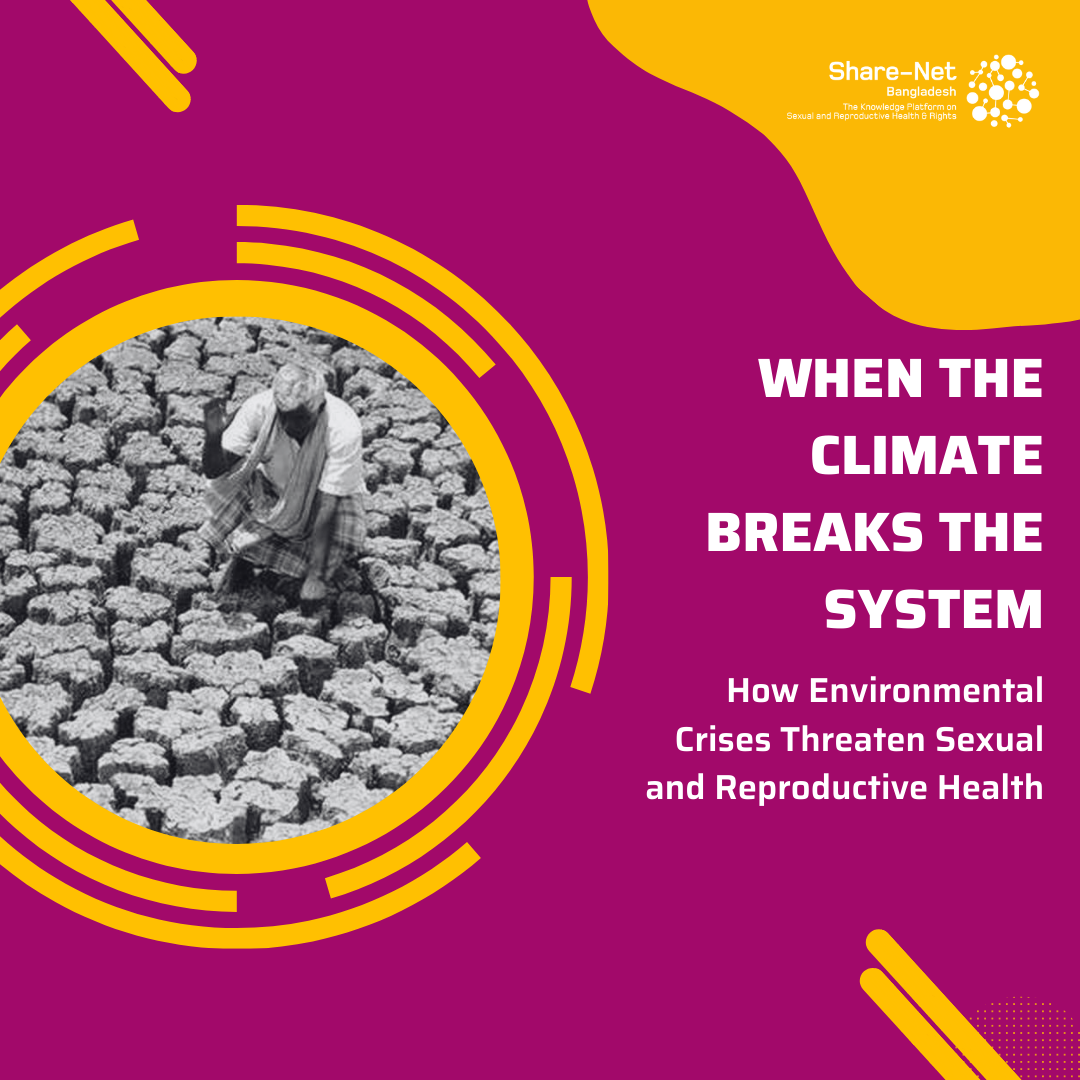
When the Climate Breaks the System: How Environmental Crises Threaten Sexual and Reproductive Health
Climate change is often spoken of in terms of temperatures, sea levels, and carbon targets. Less often do we speak of bodies. Yet across the world, environmental disasters are quietly reshaping who can access contraception, who survives childbirth, and whose safety is compromised when systems collapse.
The link between climate volatility and reproductive vulnerability is quite direct. Floods, cyclones, droughts, and heatwaves do not affect everyone equally. Women, girls, and gender-diverse people face higher risks when health services are disrupted, livelihoods vanish, and displacement becomes inevitable. Sexual and reproductive health and rights, already fragile in many contexts, are often the first to be pushed aside during a crisis.
At the global level, the United Nations has increasingly acknowledged this connection. Under the UNFCCC, discussions on climate adaptation now recognise health as a critical pillar, although SRHR is still inconsistently addressed. UNEP and the UN Environment Assembly have highlighted how climate change deepens existing inequalities, particularly for women, calling for gender-responsive climate policies. UNFPA has gone further, framing climate change as a direct threat to reproductive autonomy, maternal health, and bodily safety, especially in humanitarian settings. Still, coordination across UN bodies remains uneven, and SRHR often sits at the margins of climate negotiations rather than at their core.
Bangladesh offers a telling case. Climate change is firmly on the national agenda, reflected in the Bangladesh Climate Change Strategy and Action Plan and the Mujib Climate Prosperity Plan. At the same time, SRHR is addressed through policies on maternal health, family planning, and adolescent health. Yet these agendas rarely meet. Flood-prone districts, coastal areas, and climate hotspots continue to report gaps in maternal care and contraception access during disasters. The absence of an integrated climate and SRHR framework leaves frontline communities exposed.
Research from around the world reinforces these realities. The 2021 Lancet Countdown on Health and Climate Change documented increased risks of preterm birth and pregnancy complications during extreme heat. A 2018 WHO study on climate change and maternal health showed higher maternal mortality rates in disaster-affected regions. Research by the Guttmacher Institute, particularly the report Climate Change, Sexual and Reproductive Health, and Rights, highlighted how disrupted supply chains and clinic closures lead to spikes in unintended pregnancies following climate shocks.
These disrupted chains are not abstract. When roads are submerged and clinics damaged, contraception runs out, skilled birth attendants cannot travel, and emergency obstetric care becomes unreachable. For pregnant people, environmental stress brings both physiological and systemic danger. Heatwaves increase the risk of hypertension and dehydration. Floods raise exposure to infections, malnutrition, and unsafe delivery conditions. The stress alone can be life-threatening.
Displacement also heightens vulnerability to gender-based violence. Studies by UNHCR and CARE have shown a clear correlation between climate-induced displacement and increased risks of sexual exploitation, child marriage, and trafficking. In overcrowded shelters and informal camps, safety disappears, and access to survivor-centred care is scarce.
If climate adaptation is to be meaningful, SRHR must be integrated into its design. Policies should ensure climate-resilient health infrastructure, mobile clinics in disaster zones, protected supply chains for contraception, and GBV prevention embedded in emergency responses. Climate finance must recognise reproductive health as lifesaving, not optional.
Climate change is not only an environmental crisis. It is a reproductive justice crisis. Ignoring that truth costs lives, quietly and repeatedly.
Sources:
- UNFPA Report on SRHR in National Climate Plans
- IISD Project on Climate Change and SRHR
- IPPF Position Paper on Climate Crisis & SRHR
- Report on SRHR in National Adaptation Plans