
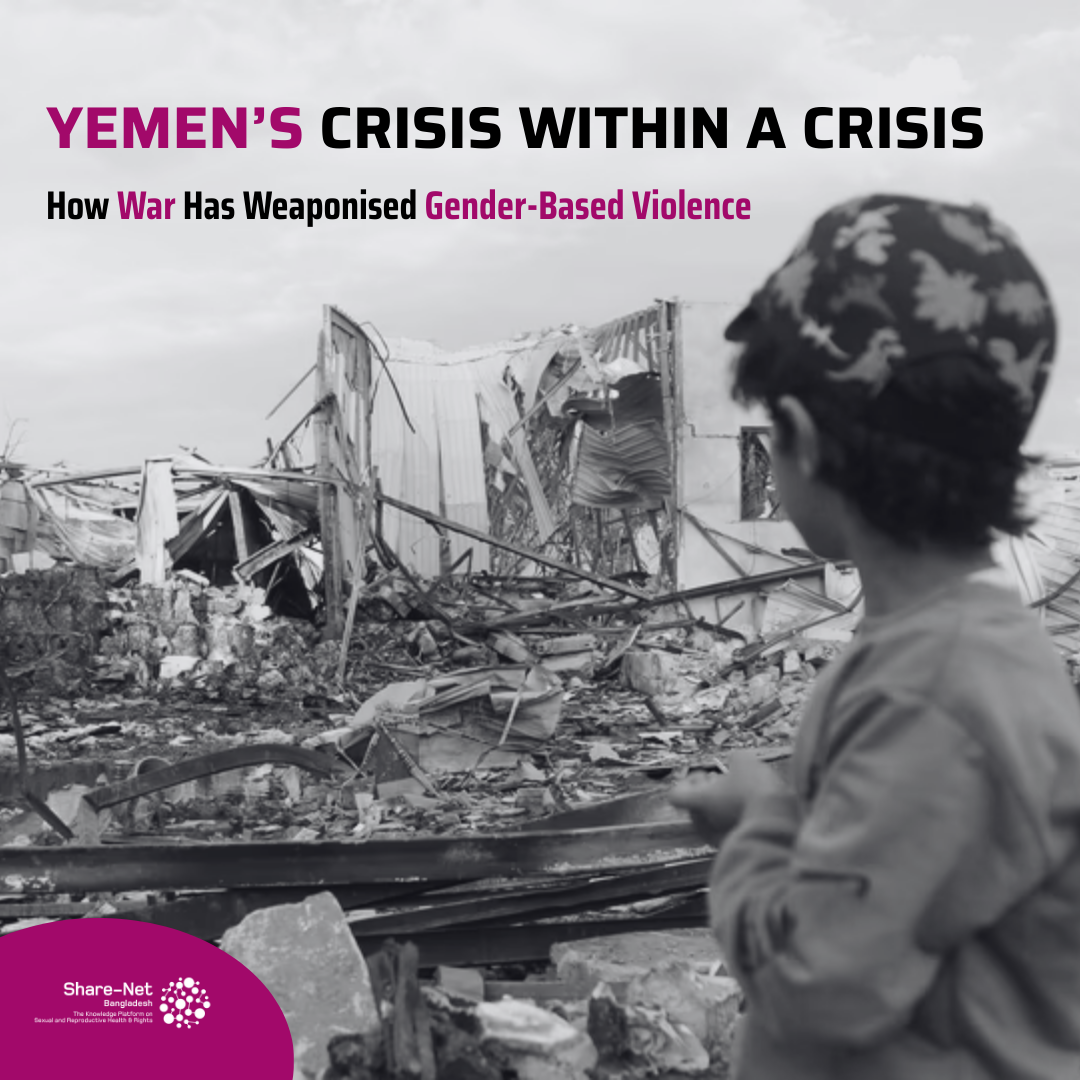
Yemen’s Crisis within a Crisis: How War Has Weaponised Gender-Based Violence
News headlines often draw our attention towards the War in Yemen. We see them, utter a sigh or two and move on. As the Security Council fails to pass another resolution on whether to de-escalate or maybe bring peace to this conflict due to vetoes; as we write thousands of reports on the situation and pass a statement condemning multiple forms of gender based violence in Yemen, time and again, we circle back to the question-is there really an end to the sufferings of the victims in Yemen?
Yemen ranks second lowest (180 out of 181 countries) in the Women, Peace & Security Index and last (172nd) in the Gender Inequality Index (GII). The ranks really do paint the picture of the epidemic of gender-based violence (GBV) against women and girls. As war continues to devastate the nation’s physical and social infrastructure, Yemeni women face increasing risks of exploitation, abuse, and neglect. This silent epidemic has become one of the conflict’s most profound and enduring legacies and earned the title, ‘’A crisis within a crisis.’’
To make things worse, access to basic services is a luxury at this point in certain regions. To access basic services in Taiz, such as health care, residents have to take routes mined with explosives and are exposed to the constant risk of shelling, airstrikes and snipers.
Women’s groups have been calling for the opening of humanitarian corridors. The Office of the United Nations High Commissioner for Human Rights reported that most healthcare facilities had been destroyed or damaged; this has a disproportionate impact on women’s health. Without access to reproductive health services, women face an increased risk of life-threatening complications. Even programmes to seek medical care abroad, such as those run by the government with the support of the King Salman Centre, lack transparency and gender responsiveness, and give priority to injured civilians and military personnel rather than civilians.
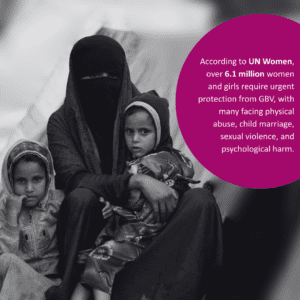
According to UN Women, over 6.1 million women and girls require urgent protection from GBV, with many facing physical abuse, child marriage, sexual violence, and psychological harm. This situation is even more concerning for internally displaced persons (IDP) camps. These camps are overcrowded and under-resourced, and in the words of UN Women, ‘’these camps strip women of their privacy and safety, leaving them vulnerable to harassment, assault, and exploitation.’’
The international community is indeed in consensus that the war in Yemen has weaponised GBV, turning it into a deliberate tool of control and domination. Some argue that GBV is a by-product of the war; others, however, believe that it is a strategic act of oppression.
The UN Human Rights Council reports that warring factions have used sexual violence to terrorise and oppress communities. In this context, the trauma inflicted on women ripples through families and communities, further eroding the social fabric and silencing women’s voices.
Furthermore, the situation is worsened by one of the most devastating forms of GBV, Digital Abuse. Many survivors of online violence experience fear, depression, and isolation, but the impacts often go beyond the psychological. A female beauty salon owner in Aden shared in an interview how a perpetrator created fake online profiles to post manipulated photos of her, resulting in the collapse of her business and the disappearance of her friends.
Worse still, online violence can turn deadly. In another case, a woman who sent her mobile phone to be serviced had her personal photos stolen by the technician, including photos of her without her veil. After he uploaded the photos onto social media, the victim’s husband found out and killed his wife. While the husband was charged, there was no law to prosecute the technician.
In yet another tragic instance, in Al Hudaydah, ongoing domestic violence and digital extortion led a girl to end her own life.
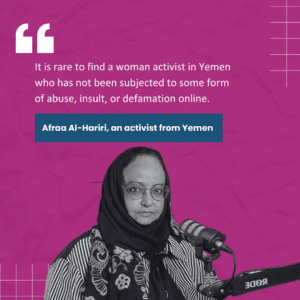
“It is rare to find a woman activist who has not been subjected to some form of abuse, insult, or defamation online, ” said Afraa Al-Hariri, an activist from Yemen.
As someone who faced bullying and defamation online herself, Hariri said in an interview with UN Women that, ‘‘Women and girls must seek safety and justice to defend their rights.’’ Anyone in Yemen who is experiencing digital violence can now file reports with the Attorney General’s Office.
This epidemic is far from over. But efforts from the international community and brave activists do have their beautiful way of making things right. Maybe we can’t solve this epidemic overnight, but each and every attempt to help matters. Share-Net Bangladesh continues to advocate for stronger protection mechanisms, survivor-centred responses, and laws that address gender-based violence in Yemen in all its forms.
Source:
- UN Women
- UNDP