
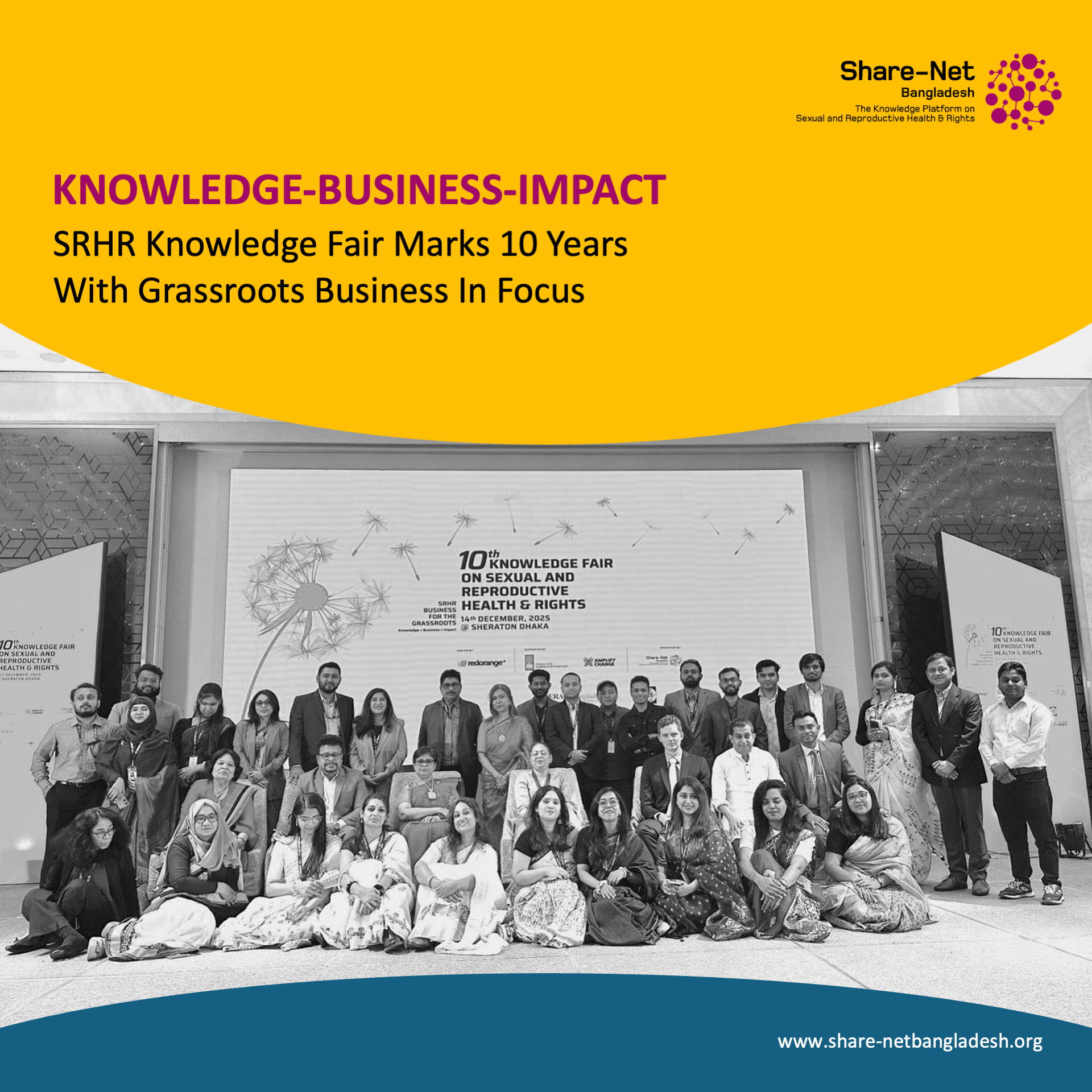
Knowledge–Business–Impact: SRHR Knowledge Fair Marks 10 Years With Grassroots Business in Focus
The 10th Annual Sexual and Reproductive Health and Rights (SRHR) Knowledge Fair in Dhaka did not feel like a routine conference. It felt like a turning point.
Held at Hotel Sheraton, the landmark event brought together more than 300 policymakers, development partners, entrepreneurs, youth leaders, and public health experts to explore a bold idea: SRHR must move beyond short-term projects and become part of sustainable, grassroots business models. Organised by Share-Net Bangladesh and RedOrange Limited, with support from the Embassy of the Kingdom of the Netherlands and AmplifyChange, the fair marked a decade of SRHR knowledge-sharing with a future-facing theme—“SRHR Business for the Grassroots.”
“At this year’s fair, we will know how we can use the power of business to ensure SRHR,” said Arnob Chakrabarty, Project Director of Share-Net Bangladesh. The message was echoed across sessions: investing in sexual and reproductive health is not charity, it is smart social investment.
This matters deeply in Bangladesh, where SRHR challenges remain urgent. According to national and UN data, more than half of women are married before 18, gender-based violence remains widespread, and access to youth-friendly sexual health services is uneven. Rising rates of sexually transmitted infections, online harassment, and unsafe maternal health practices show that traditional models alone are not working.
“STI and HIV are rising. With low development funding, collaboration between public, private, and NGO platforms is crucial,” warned Toslim Uddin Khan, CEO of SMC. His comment reflected a wider concern: shrinking donor funds are colliding with growing SRHR needs, from menstrual health management to mental health support for survivors of violence.
Government officials emphasised sustainability and ownership. “To make family planning programmes sustainable, the Government of Bangladesh is focusing on building its own capacity instead of depending on foreign funding,” said Dr Ashrafi Ahmad, Director General of DGFP. Dr Nazneen Kawshar Chowdhury of the National Skills Development Authority added, “Lack of access to SRHR directly affects people’s dignity and safety—and without working on it, we cannot ensure empowerment.”
But the fair also carried a note of caution. Shireen Huq, Chairperson of the Women’s Affairs Reform Commission, warned against unchecked commercialisation of maternal health. “A basic service like childbirth is being commercialised, leading to unnecessary C-sections,” she said, pointing to the urgent need for ethical, community-rooted models that protect women’s rights rather than exploit them.
Innovation was at the heart of the fair. Grants were awarded to youth-led initiatives, including Nirbhoya, a tech-based SRHR platform aiming to support women facing violence, harassment, and health barriers, and a digital learning research project focused on expanding access to SRHR knowledge. These initiatives reflect how social business can address gaps in GBV response, youth-friendly counselling, and safe online spaces.
Closing the event, Mushfiqua Zaman Satiar from the Embassy of the Kingdom of the Netherlands stressed, “When business grows with a non-profit social business concept, it can create real impact.”
After ten years, the SRHR Knowledge Fair is no longer only about exchanging ideas. It is about building systems that last—where knowledge meets enterprise, and where grassroots solutions protect sexual health, reproductive rights, and the dignity of those most often left behind.
