
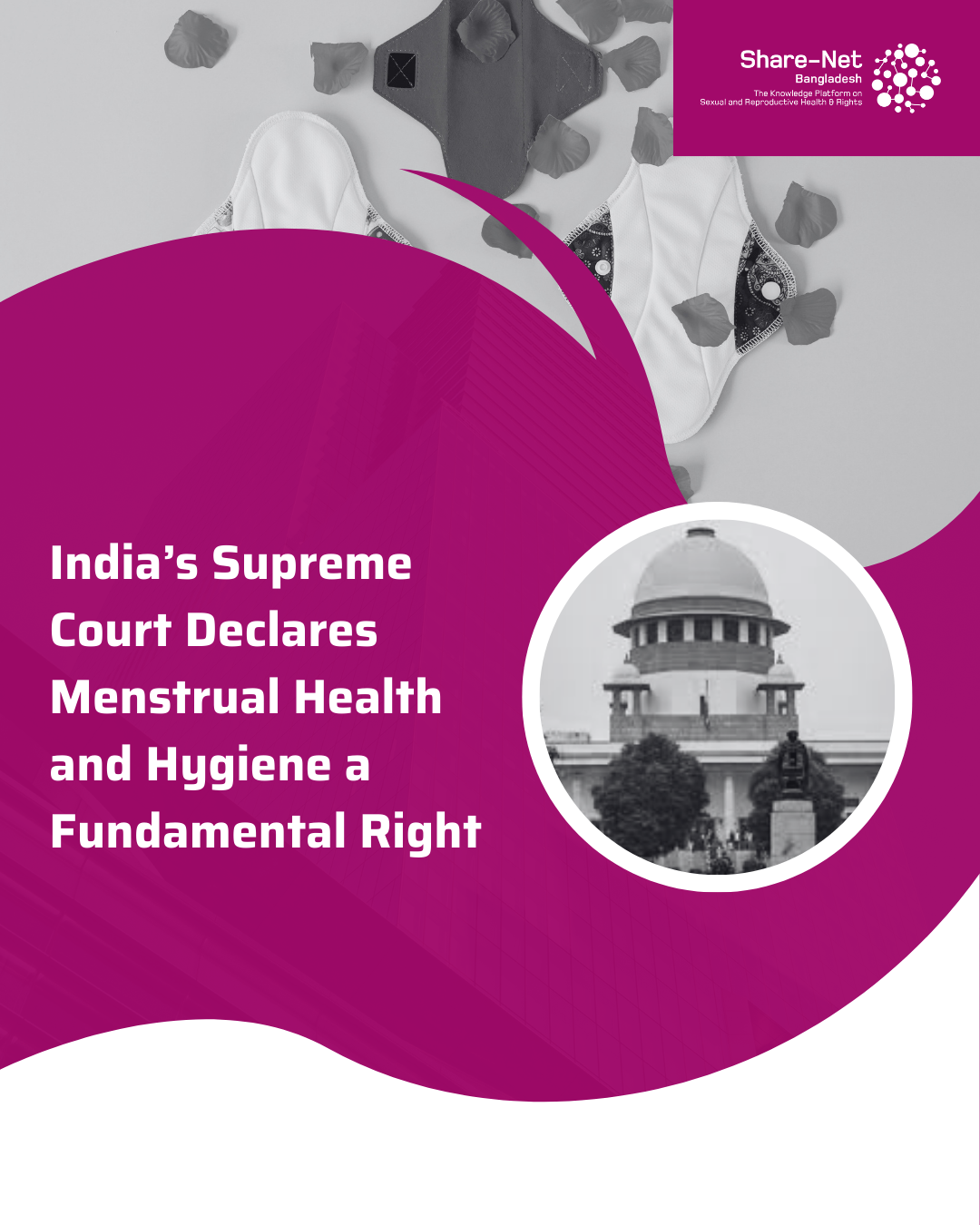
India’s Supreme Court Declares Menstrual Health and Hygiene a Fundamental Right
For decades, the biological reality of menstruation has been treated as a whispered secret in the corridors of Indian schools. It is a topic often skipped over in textbooks, hidden behind the rustle of black plastic bags, and shrouded in a silence that carries a high cost.
On 30 January, the Supreme Court of India shattered that silence with a landmark declaration: access to menstrual hygiene is not a luxury or a mere health issue; it is a fundamental right.
The Court held that menstrual hygiene is an integral part of a girl child’s right to life, dignity, and education. By framing it this way, the judiciary has acknowledged a truth that millions of girls live every day, that the lack of a simple sanitary pad or a private toilet can be the wall that stands between a girl and her future. The ruling issued mandatory directions to all states to provide free biodegradable sanitary napkins and separate toilets in schools, recognising that without these, the promise of equal education remains a myth.
The data highlights the urgency of this intervention. In India, approximately 23 million girls drop out of school annually due to a lack of menstrual hygiene management facilities. Even for those who stay, the experience is often one of anxiety and exclusion. Only about 36 per cent of the 355 million menstruating women in India use sanitary napkins, with the rest relying on unsafe alternatives like old rags, husks, or even ash. This isn’t just a matter of convenience; it is a critical component of Sexual and Reproductive Health and Rights (SRHR).
When we talk about SRHR, we often focus on maternal health or family planning, but menstrual health is the foundation. It is the first point of contact many young girls have with their reproductive rights. If they are taught that their period is something to be ashamed of or something that restricts their movement, it sets a precedent for how they view their bodily autonomy for the rest of their lives.
India is not alone in this journey, but it is now part of a small, progressive group of nations. Scotland made history in 2020 by becoming the first country to make period products free for everyone. Kenya and South Africa have also taken significant steps, abolishing taxes on menstrual products and providing them in schools. By elevating this to a “fundamental right,” India has arguably gone a step further, placing the burden of responsibility squarely on the state to ensure no girl is left behind because of a natural biological process.
This ruling is a constitutional moment that moves the conversation from charity to entitlement. It tells every school-going girl that her dignity is non-negotiable and her education cannot be stymied by biology. The “pocket educator” of the digital age and the high benches of the law are finally converging on the same point: it is time to unstaple the pages of the health manual and give menstrual dignity the space it deserves in the sun.
Source:
- HHR Journal
- The Diplomat – Asia-Pacific Current Affairs Magazine
- The Supreme Court of India